
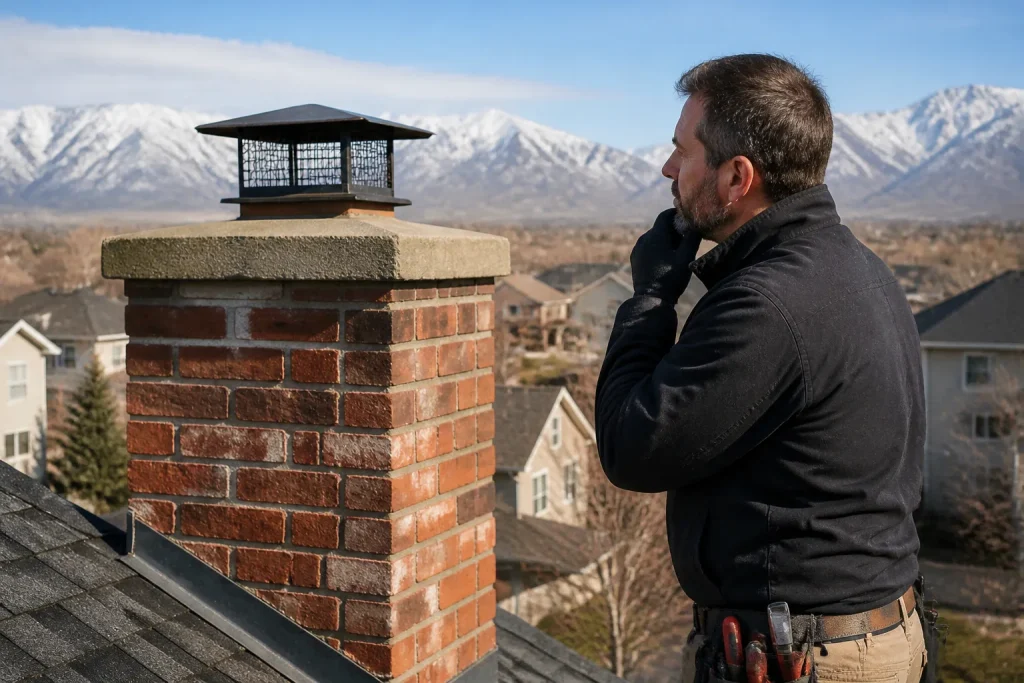
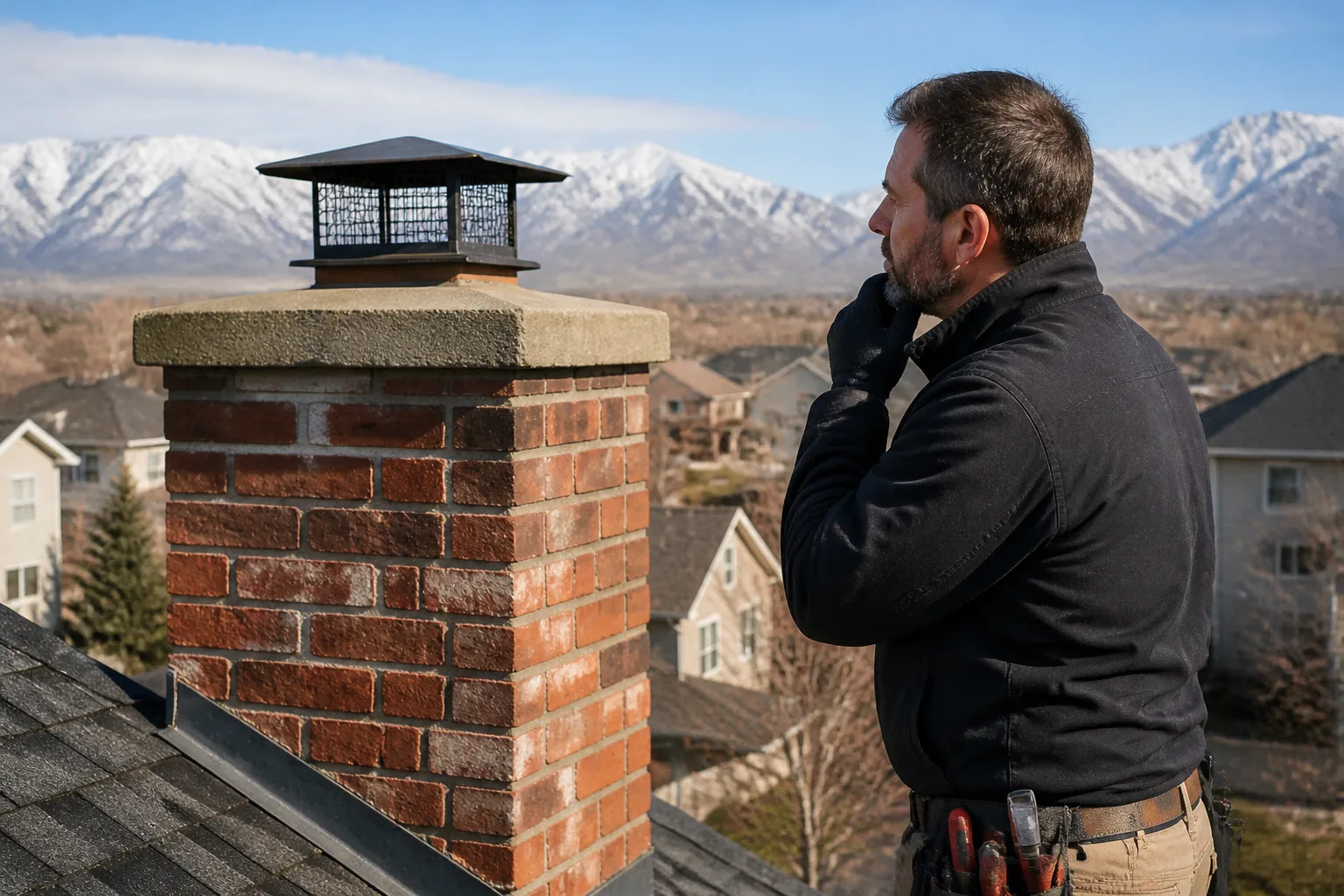
Chimney Sweep: Repair or Replace? How Layton Homeowners Decide
The most expensive chimney mistake Layton homeowners make isn’t choosing to replace when they should repair. It’s repairing a symptom while the structural cause keeps degrading underneath. A rebuilt crown over a failing liner, or a patched firebox on a flue that’s already lost its lining, buys a season or two before the same problem returns with a bigger invoice. Deciding between repair and replacement comes down to diagnosing which component is actually failing, and whether the fix addresses the cause or only the visible damage.
If you’d rather have a trained eye read the evidence before you commit to anything, call (888) 861-5852. We answer 24/7. Fast dispatch from 7am to 7pm, Sunday through Friday.
Key Takeaways
- Diagnose the failing component first. Liner, crown, cap, firebox and masonry each have their own repair-versus-replace tipping points.
- Utah’s freeze-thaw cycles punish masonry and crowns harder than milder climates, which shortens the lifespan of a patch-and-wait repair.
- A Level II inspection gives you the documentation a sweep report doesn’t. It’s the difference between a guess and a decision.
- For a compromised system, one full liner replacement often costs less over a decade than repeated targeted repairs.
- Prefabricated chimneys hit end-of-service-life differently than masonry ones, and Layton’s housing stock has plenty of both.
Why the Repair-or-Replace Question Isn’t Really About Cost
Homeowners in Layton usually frame the decision as a price comparison: what does a repair cost versus what does a replacement cost? That framing leads people wrong. The real question is whether the repair you’re buying actually fixes the root cause or just restores the surface.
A chimney is a system of components that fail on different schedules. The liner contains combustion gases. The crown sheds water at the top. The cap keeps rain and animals out. The firebox holds the fire. The masonry ties it all together. When one component fails, the ones around it start working harder and aging faster. Patch the crown but ignore a cracked liner, and you’ve protected the top of the chimney while the interior keeps deteriorating.
What matters is knowing which component has failed, how badly, and whether the surrounding components are still healthy enough to keep doing their jobs. That’s a diagnosis, not a sales decision. In our experience, the homeowners who regret their chimney work most are the ones who paid for a repair that fixed the symptom and left the cause in place. The fix looked fine for a season or two. Then the same water stain came back, or the same draft problem, and the second repair cost more than doing it right the first time would have.
So before you compare repair and replacement quotes, get clear on what’s actually wrong. That’s where the component-by-component framework below comes in.
Component by Component: How Each Part Tips the Decision
Each chimney component has a specific set of failure conditions that point toward repair and a different set that point toward replacement. Reading them individually keeps you from replacing an entire system over one fixable part, or saving a part that’s past saving.
The liner: the most consequential call
The liner is the component most often misdiagnosed and most often the reason a repair turns into a replacement later. A clay tile liner with a hairline crack or two can often be restored with HeatShield ceramic resurfacing, a specialized liner repair system most local sweep companies don’t carry or know how to apply. That’s a genuine repair that addresses the interior surface where the damage is.
But when the tiles are spalling, offset, or missing in sections, resurfacing can’t rebuild a structural flue. That’s where a full liner replacement earns its keep, and where a DuraFlex flexible stainless liner is the professional standard for relining a deteriorated or oversized flue. The tipping point is structural integrity: resurfacing restores a sound flue, it doesn’t replace a broken one.
The crown: repair usually wins
The crown is the concrete or masonry cap at the very top that sheds water away from the chimney. Cracks and spalling here are extremely common in Layton, and in most cases, crown repair or rebuilding is the right move. A failing crown lets water into the masonry below, so fixing it early protects everything underneath.
The cap: almost always replace
The chimney cap is the metal or mesh cover over the flue opening. Rusted, bent, or missing caps are a straightforward replacement. This is one of the least expensive components to address and one of the most consequential to neglect, because a missing cap invites water, birds and debris straight into the flue. We stock caps from names like Gelco and Copperfield, sized to fit properly rather than a universal piece that rattles loose.
The firebox and masonry: the judgment call
The firebox takes the direct heat and the masonry carries the load. Minor firebox cracks can be repaired. Widespread spalling, crumbling mortar joints, or a firebox that’s lost its shape point toward more involved work. This is where a documented assessment matters most, because the line between repairable and not depends on what’s behind the surface. To learn how we approach this kind of work, see fireplace repair.
How Utah’s Freeze-Thaw Cycles Change the Equation
Layton sits where winter swings above and below freezing repeatedly, and that pattern hits chimneys in ways that milder climates don’t. Water soaks into porous masonry or a hairline crown crack during a warm afternoon, then freezes and expands overnight, then thaws and drains the next day. Each cycle widens the crack a little more. Over a full winter, that’s dozens of cycles working the same failure open.
What that means for your repair-or-replace decision: a patch applied to masonry that’s actively freeze-thaw cycling has a shorter useful life here than the same patch would have in a climate with a stable cold season. A repair that might hold for years somewhere milder might need revisiting after a couple of winters if the underlying masonry is still absorbing water. That’s not a reason to skip repair; it’s a reason to fix the water source first. Waterproofing the crown, confirming the cap is intact, and sealing spalled masonry all extend how long a repair lasts.
It also means a Layton chimney with a history of repeat repairs on the same component is telling you something. The freeze-thaw cycle keeps finding the weak point. If you’ve patched the same area more than once, that’s a signal the underlying structure is where the problem lives, not the surface.
Why a Level I Sweep Report Isn’t Enough to Decide
A chimney sweep is a cleaning service. A Level I inspection is a basic check of what’s visible without special tools. Neither one gives you the information to confidently decide repair versus replacement, because neither looks inside the flue or documents the structural condition in a way you can act on.
A Level II inspection is the diagnostic step that generates the documentation you actually need. It includes a camera scan of the flue interior, an assessment of the liner, and a written report on each component’s condition. That report is the difference between “the sweep said it looked okay” and knowing exactly which parts are sound, which are marginal, and which have failed.
We offer chimney inspections as a standalone service, not a sales pitch attached to a cleaning. If your chimney is fine, we say so. If it needs work, you get photo documentation you can hold onto, which also helps if you’re buying or selling a home in Layton or dealing with an insurer. A formal inspection report is the most useful thing you can bring to the repair-or-replace decision, and it’s the piece most homeowners skip. To book a dedicated inspection, start with Chimney Sweep Layton.
Cost of Ownership: When Replacement Is the Cheaper Path
It’s tempting to compare the price of a repair today against the price of a replacement today and pick the smaller number. The more useful comparison is over a longer horizon. A single full liner replacement often costs less over ten years than a string of targeted repairs on a system that’s failing in multiple places.
Here’s the logic. Each targeted repair buys you time, but on a compromised system, the next failure arrives sooner because the surrounding components are also aging. You’re paying not just for the repairs but for repeated inspections, repeat visits, and the inconvenience of a chimney that keeps needing attention. A proper replacement resets the clock on that component and stops the cycle.
Replacement isn’t always the answer. A structurally sound chimney with one failing component is a repair job, plain and simple, and replacing it would waste money. The cost-of-ownership math only tips toward replacement when the system has multiple failing or marginal components, a history of repeated repairs on the same spot, or a liner that’s compromised beyond what resurfacing can restore. That’s the point where one proper fix is cheaper and less aggravating than three incremental ones. When the repair involves structural changes, see chimney repair for how that work is scoped.
Age, Chimney Type and Repair History: Weighting the Decision
Three factors should carry real weight alongside the component assessment: how old the chimney is, whether it’s masonry or prefabricated, and what repair history it already carries.
Masonry chimneys are built to last a long time, and age alone rarely means replace. A well-maintained masonry chimney can be repaired component by component for decades. What tips a masonry chimney toward replacement is cumulative structural failure, not the calendar.
Prefabricated chimneys follow a different rule. They’re engineered systems with a defined service life, and once they reach end-of-service-life, repairs start costing more than they’re worth because the whole assembly is aging together. Specific indicators that a prefabricated Layton chimney has reached that point include:
- A factory-built liner that’s failed or delaminated across its length, not just at one spot.
- Repeated repairs on the same section within a short span.
- Visible damage to the chase or the connection between the chimney and the appliance.
- An inspection report noting widespread deterioration rather than isolated flaws.
Repair history matters for both types. One repair handled well is a normal maintenance story. The same repair coming back every couple of years is a system telling you it’s time for a bigger conversation. That’s where professional materials from names like Olympia Chimney and Famco matter, because the parts you install now determine how long the fix holds. We use the same materials certified chimney professionals specify, not hardware-store substitutes. Built to last, not built to get us back next season.
When to Call a Pro
Some of this is checkable on your own. Cracked crowns, rusted caps and visible firebox damage you can spot from the ground or a safe vantage. But the liner, the flue interior and the structural condition behind the masonry are not things you can assess without a camera and training, and they’re exactly where the repair-or-replace decision gets made. A chimney that’s actively degrading can also pose a real safety concern, from fire risk in a compromised flue to carbon monoxide if a liner has failed. Don’t test that with a flashlight and optimism.
If you’d rather not climb around on your own roof, call (888) 861-5852 and we’ll take it from there. Our technicians have up to 8 years of experience, and the estimate is free.
Related services in Layton
We handle the full chimney system from the firebox to the crown, including a routine chimney sweep when that’s all you need. One company handles the sweep, the inspection, the repair and the cap, with no handoffs and no gaps.
The Bottom Line
Repair versus replace is a diagnosis question, not a pricing question. Read each component on its own: a hairline liner crack may be a HeatShield resurfacing job, while a spalled, offset flue may need a DuraFlex reline. A cracked crown is usually a repair. A rusted cap is a simple replacement. The full-replacement call earns its place when multiple components are marginal, when freeze-thaw cycles keep reopening the same patch, or when a prefabricated chimney has clearly reached the end of its engineered life.
Get a Level II inspection first. It gives you the documentation to make the call with confidence instead of guesswork, and it’s the piece most homeowners skip on the way to a decision they regret. If you’re in Layton and need help, Chimney Sweep Layton offers free estimates. Call (888) 861-5852. We answer 24/7. Fast dispatch from 7am to 7pm, Sunday through Friday.
Frequently Asked Questions
Most chimneys should be swept once a year if you burn regularly, and inspected at the same time so the sweep catches liner and crown problems before they turn into structural repairs. If you burn often or use unseasoned wood, a mid-season check is worth it. Call (888) 861-5852 for an exact quote on a sweep and inspection, and the estimate is free.
A sound flue with cracks or surface damage can often be restored with HeatShield ceramic resurfacing instead of a full replacement. A flue that’s spalled, offset or missing tiles needs a full liner replacement, usually with a DuraFlex flexible stainless liner. The right answer depends on what the camera sees, not on the age of the chimney. Call (888) 861-5852 and we’ll show you the evidence before recommending anything.
In Layton, waiting through a winter usually means the freeze-thaw cycle keeps widening whichever crack or joint let water in. A small crown crack can become a saturated masonry section. A marginal liner can fail entirely. Some repairs can safely wait a season; others shouldn’t. A proper inspection tells you which category you’re in, so you’re not guessing. Call (888) 861-5852 for a free estimate.
Yes. A Level II inspection includes a camera scan of the flue and a written report on each component, which is exactly the documentation a repair-or-replace decision needs. A cleaning or Level I check doesn’t go far enough to answer the question. We offer inspections as a standalone service so you get an honest assessment, not a sales pitch. Call (888) 861-5852 for a free estimate on your inspection.
Written by the team at Chimney Sweep Layton.
Need Chimney Cleaning Help?
Call Chimney Sweep Layton - the local pro we connect you with is licensed and insured, here with fast help in Layton.
(888) 861-5852